
By the T-Series StageWorks Team
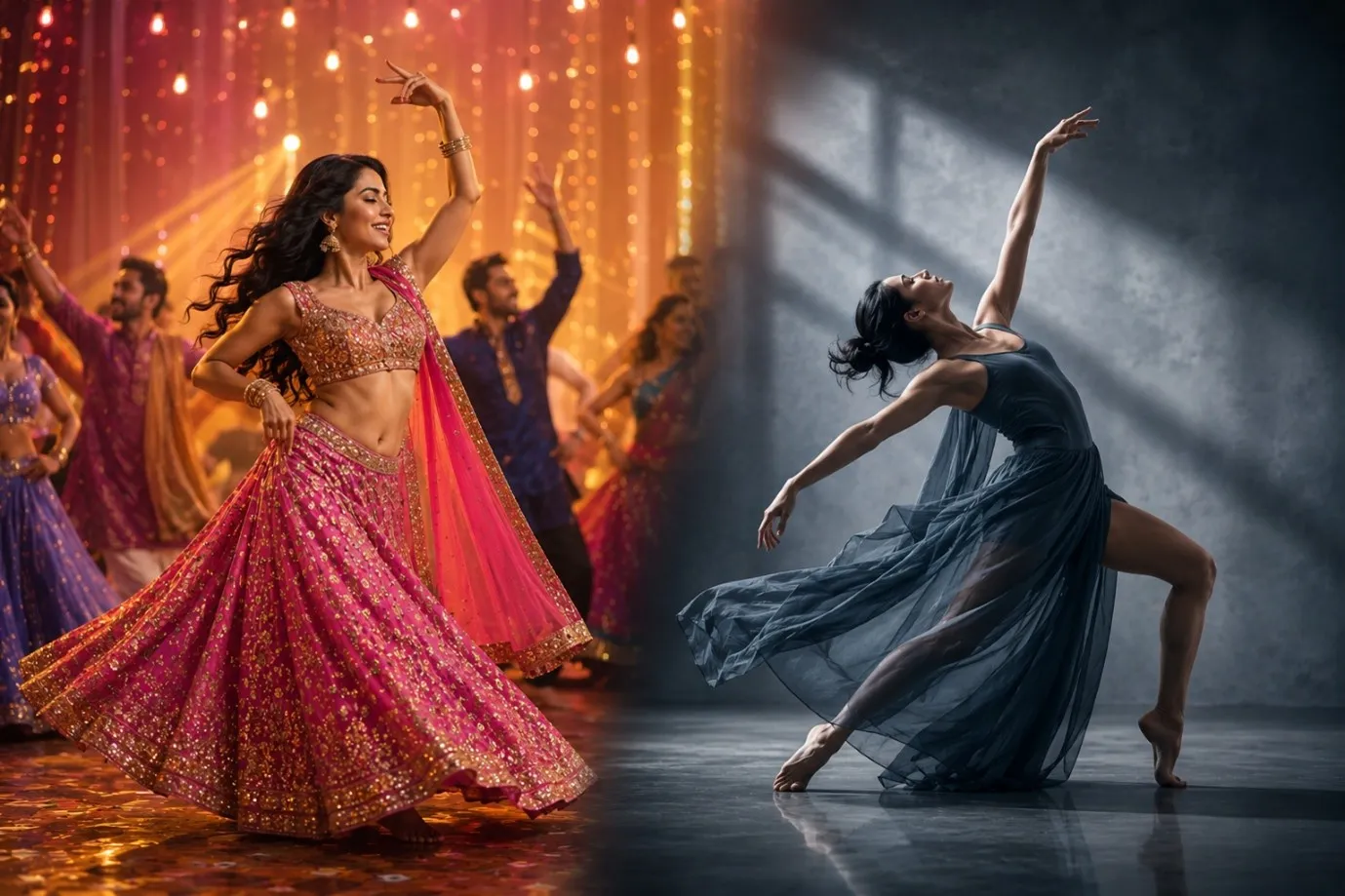
Anyone weighing a dance diploma against a more general dance hobby usually narrows the decision down to one question fairly quickly: Bollywood or contemporary? Both build strength, rhythm, and stage presence, but they ask very different things of a dancer's body and personality. T-Series StageWorks sees students arrive with strong opinions about which style they "should" choose, and just as often watches those opinions shift once they actually try both in a structured setting. The honest answer almost always depends less on which style looks more impressive and more on which one a dancer's body and temperament naturally lean toward.
| Bollywood | Contemporary | |
|---|---|---|
| Movement style | Fixed steps on a fixed count, sharp and snapping | Breath- and weight-led, often without a strict count |
| Energy | High, outward, sustained for a 3–4 minute number | Internal, can be quiet and unresolved |
| Music | Film soundtracks, recognizable songs and lyrics | Instrumental, ambient, sometimes silent passages |
| Core skill | Facial expression, formation changes, stamina | Floor work, balance, controlled falls |
| Career paths | Sangeet/wedding choreography, reality shows, music videos | Concert dance companies, experimental theatre |
| Paid opportunity in India | Larger and faster-growing | Smaller, more specialized |
Bollywood choreography is built around storytelling through expression as much as movement — a raised eyebrow, a held smile, a dramatic turn of the head are as much a part of the technique as footwork. A typical class breaks a song into eight-count phrases, layering formation changes, hand gestures, and facial expression onto a fixed rhythm pulled directly from the film soundtrack. The style rewards dancers who enjoy performing outward, toward an audience, with high energy sustained across a three-to-four-minute number. Physically, it demands quick bursts of cardio stamina and sharp, snapping movement quality rather than slow control, which is why dancers describe it as exhausting in a different way than a long endurance workout.
Contemporary works from the opposite direction — instead of hitting a fixed step on a fixed beat, dancers are trained to respond to breath, weight, and momentum, often without a strict count to follow. Core skills built in a typical contemporary class include:
This makes contemporary training particularly demanding for dancers used to performing outward toward an audience at all times.
The soundtrack a dancer is drawn to is often a more honest signal than the style's reputation. Bollywood choreography is inseparable from its film music — the steps are frequently built to mirror specific lyrics and beats from a known song, so a dancer who naturally moves to film music, or who enjoys performing to songs the audience already recognizes, tends to thrive here. Contemporary is usually set to instrumental, ambient, or even silent passages, which means the dancer has to generate the emotional content themselves rather than ride a recognizable hook. Students who feel restless without a strong beat to follow generally gravitate toward Bollywood; students who enjoy interpreting open-ended music tend to prefer contemporary.
Career direction matters as much as personal taste:
A student aiming for commercial entertainment work in India is usually better served leaning toward Bollywood first, even if contemporary appeals to them personally, simply because that's where the volume of paid opportunity currently sits. This doesn't make contemporary a poor choice — it simply means the timeline to paid work tends to be longer and more dependent on a smaller, specialized circuit of companies and collaborators.
Most professional dancers eventually train in more than one style, because the skills cross-pollinate more than they compete. Bollywood sharpens performance energy and audience connection; contemporary sharpens body control, floor awareness, and emotional nuance — and dancers who have both tend to book a wider range of work than specialists in either. A reasonable starting point is picking whichever style matches current personality and interest, finishing a structured course in it, and then deciding whether to specialize or branch out based on what the training actually revealed about preference, rather than guessing in advance.
There's no universally "better" style — only a better fit for a given dancer's energy, music taste, and goals. T-Series StageWorks Academy's Bollywood program in Noida is a practical place to start building that vocabulary, especially for anyone comparing a dance diploma before deciding whether to branch into contemporary later.